


Endodontic retreatment

A second chance to save a tooth that still matters

Sometimes a tooth that has already had a root canal develops new symptoms, persistent infection, or does not heal the way everyone hoped.

Credentials and Affiliations

Microscope Guided Endodontics
CBCT 3D Imaging
GentleWave System

Why retreatment can be more involved

Finding the reason a prior root canal did not fully resolve the problem

Retreatment is often less about repeating a procedure and more about uncovering what was missed, what changed, or what is now preventing healing. That may include narrow or hidden canals, calcified anatomy, previous restorative leakage, recurrent decay, or anatomy that simply did not show itself clearly the first time.

Because these cases can be more technically demanding, the value of magnification, lighting, imaging, and thoughtful case selection becomes even more important. Our office uses a focused workflow built around careful diagnosis before the tooth is reopened.

Often referred for Patients who want to save a previously treated tooth before considering extraction

Persistent discomfort or radiographic signs around a tooth that already had a root canal

Complex anatomy, missed canals, or prior treatment details that deserve a more advanced review

Patients across Winter Garden, Windermere, Horizon West, Ocoee, Clermont, and greater Central Florida seeking an endodontic office focused on saving teeth

Who may be a good candidate

Signs retreatment may be worth considering

Not every previously treated tooth should be retreated, but many can be. The key question is whether the tooth remains restorable and whether there is a clear clinical reason to believe another attempt can improve the outcome.

Symptoms

Pain that returned after a prior root canal

Some teeth become symptomatic again because infection persisted in difficult anatomy or reentered through a leaking restoration.

  • Recurring pain or pressure when chewing
  • Lingering tenderness in a previously treated tooth
  • Intermittent flare ups months or years later
Referral reasons

A previous root canal that deserves an advanced evaluation

Your general dentist may refer you when the diagnosis is unclear, when symptoms do not match the X rays well, or when advanced technology is needed to decide whether retreatment or another option makes the most sense.

  • Missed canal suspicion or complex anatomy
  • Calcification, posts, or restorative obstacles
  • A tooth you hope to save if there is a predictable path forward

Who may be a good candidate

Signs retreatment may be worth considering

Not every previously treated tooth should be retreated, but many can be. The key question is whether the tooth remains restorable and whether there is a clear clinical reason to believe another attempt can improve the outcome.

Symptoms

Pain that returned after a prior root canal

Some teeth become symptomatic again because infection persisted in difficult anatomy or reentered through a leaking restoration.

  • Recurring pain or pressure when chewing
  • Lingering tenderness in a previously treated tooth
  • Intermittent flare ups months or years later
Referral reasons

A previous root canal that deserves a specialist review

Your general dentist may refer you when the diagnosis is unclear, when symptoms do not match the X rays well, or when advanced technology is needed to decide whether retreatment or another option makes the most sense.

  • Missed canal suspicion or complex anatomy
  • Calcification, posts, or restorative obstacles
  • A tooth you hope to save if there is a predictable path forward

What to expect

How endodontic retreatment usually works

01

Diagnosis and treatment planning

We review symptoms, prior dental history, and current restorations, then use digital radiographs and limited field CBCT when the added three dimensional detail can help identify missed anatomy, recurrent infection, fractures, or restorative limitations.

02

Careful re entry into the tooth

Previous restorative materials and root canal filling materials are removed in a controlled way so the canal system can be re evaluated from the inside out under magnification.

03

Cleaning, disinfection, and sealing

The canals are reshaped as needed, disinfected with modern irrigation protocols, and sealed again once the internal system has been addressed as completely and conservatively as possible.

In some cases, retreatment may reveal that the tooth would be better served by endodontic surgery or that it is no longer predictable to save. The purpose of the evaluation is to guide you honestly toward the option that best protects your long term health.

What recovery is usually like

Recovery is often similar to a root canal, though some retreatment cases are more involved because previous materials must be removed and anatomy can be more complex. Mild tenderness for a short time can be normal. As with any endodontic case, the final restoration from your general dentist remains an important part of protecting the tooth.

Modern Dreyer office treatment setting

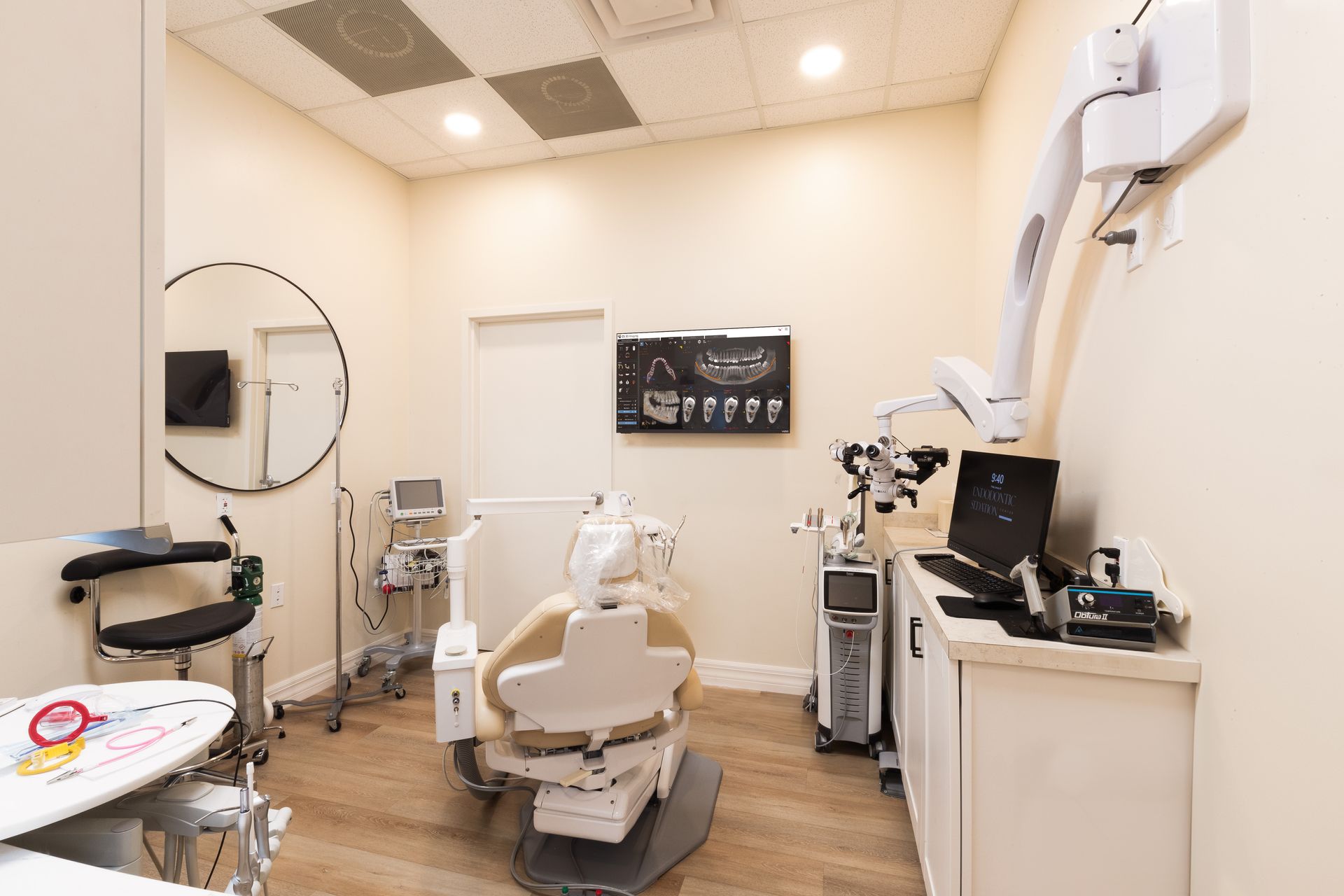
State of the art tools

What makes our office different

Modern root canal treatment is about more than hand skills alone. The right technology helps refine diagnosis, improve visualization, and support disinfection inside spaces that are too small and complex to judge with the naked eye.

3D imaging when it adds value

Limited field CBCT can be helpful when two dimensional images do not explain symptoms clearly or when anatomy, calcification, prior treatment, or hidden pathology need a more exact view.

Microscope guided treatment

Operating microscope magnification helps reveal fine anatomy, extra canals, cracks, and other details that can change treatment decisions.

Laser supported irrigation and disinfection

Laser technology can be used as an adjunct to irrigation and disinfection protocols, helping activate fluids within the canal system. It is part of a modern toolkit, not a shortcut, and treatment is chosen case by case.

Advanced workflow Precision, visualization, and disinfection working together

Imaging is selected carefully, with limited field scans reserved for cases where the added detail can improve diagnosis or treatment planning

Magnification and illumination support cleaner access, better detection of anatomy, and more controlled treatment

Advanced irrigation systems, including laser assisted protocols, are used to support canal cleaning in a conservative and modern way

Why do root canals sometimes fail?

A previous root canal can fail for different reasons. Sometimes anatomy was hidden or unusually complex. In other cases, bacteria found a way back into the tooth because a crown or filling leaked or because new decay developed. Occasionally, the issue is not bacterial at all but structural, such as a crack that changes the long term outlook of the tooth.

Is retreatment always the best option?

No. Some teeth are better treated with endodontic surgery, and some are no longer good candidates for preservation because of fracture, loss of tooth structure, or restorative limitations. The value of the consultation is that it helps separate the teeth that can still be treated predictably from the ones that may need a different solution.

Local care for Central Florida patients

Our office serves Winter Garden, Windermere, Horizon West, Ocoee, Clermont, Oakland, Dr. Phillips, and surrounding Central Florida communities with patient-focused endodontic care designed around diagnosis, precision, and honest treatment planning.

FAQ

How do I know if I need endodontic retreatment?

Symptoms such as recurring pain, pressure when chewing, swelling, drainage, or a persistent area of infection around a previously treated tooth can all be reasons to have the tooth evaluated by an endodontist.

Is retreatment more difficult than a first time root canal?

It often can be, because the tooth has already been treated and prior materials may need to be removed before the internal anatomy can be reassessed. That is one reason advanced imaging and microscope guided treatment can be especially valuable.

Can a retreated tooth last?

In the right case, yes. Longevity depends on the reason for failure, the condition of the tooth, the quality of the final restoration, and whether the tooth remains structurally sound and restorable.

Why mention lasers and advanced technology?

Retreatment is often about details. Tools like limited field CBCT, operating microscope magnification, ultrasonic instrumentation, and laser assisted irrigation can support more informed diagnosis and more refined treatment when selected for the right case.

Do I still need to see my general dentist afterward?

Usually, yes. The final restoration remains a major part of protecting the tooth after retreatment, so follow up with your restorative dentist is still important.

Need an opinion on a failed root canal?

We can review your symptoms, imaging, and restorative history to help determine whether endodontic retreatment is the right next step for your tooth.